Customer Validation x Founder Led Sales
How to steer your way into finding Product Market Fit, while generating your first 10 users

👋 Hey, Max here! Welcome to my weekly newsletter. Each week I tackle topics about startups, B2B growth, and personal development. Subscribe to get this newsletter every week 👇
I’ve been doing founder-led sales for different SaaS projects I built up. I’m still figuring a lot out myself, but hopefully, there are some nuggets in here, that are going to be helpful to you.
What makes founder-led sales unique
What is founder-led sales?
What's unique about founder-led sales is that you are usually doing customer interviews to find PMF and sell your product simultaneously.
When selling a product after launch, you have a solid sales pitch, formal pricing, and a process you want to execute. You and your sales team have confidence in the product and the course because it's battle-tested. Your team has done it a hundred times. They know what resonates.
When starting still need to figure it all out when it comes to early sales. You have a barebones process, a pitch that you're not sure will work, a product that's still in development and probably doesn't have a formal pricing strategy.
This makes the sales process very different. It has to be a creative process that you keep repeating. After every call, you need to think about how to advance the playing field.
This is one of the many reasons why founders have to sell themselves. An essential difference from founder-led sales is the positioning discussed with interested parties. In my experience, framing those calls as “feedback calls” works best to talk to as many people as possible.
Some tips on execution
Our goal is to figure out how to improve our product, not generate revenue. But you still want to charge your user money to validate how much they want it.
I mainly wanted to know: What are the features we needed to build to get the customer excited about the product?
The "feedback" positioning makes it easier to get conversations with folks. This is not just a sales tactic since you optimize to generate high-value feedback from your ideal customers.
During feedback calls, you start with a script of validation questions about your product and assess your most critical questions.
By doing that, you will also feel your counterpart's pain points and thoughts. By the mid of the call, you should have identified how heavily you can pitch your product at the end of the interview process. If they don't seem interested for whatever reason, try to steer this call towards the interview direction and gather as much in-depth user feedback as possible. Understand their pain points, workarounds, and how you can potentially help them out in the future.
💡 Pro Tip: Even if prospects are not interested, they are probably connected with other people that fit your ICP (ideal customer profile). Proactively ask for intros to 2-3 of friends of them you should talk to. Make it as easy as possible for them to introduce you by sending over a quick blurb about your product and why it would be interesting for them to talk to you.
Connecting the dots across calls
While on demo calls and between calls, try to find patterns. For this, it's essential to talk to a narrowly defined target group. This will make it much easier to spot potential pain points.
You should go into the call aiming to answer the following questions:
Are we building the right overall product? Is our vision correct?
What features do we need to build?
What's the order of features we need to build? How do we prioritize?
Am I talking to the right person? Is this our ICP?
What do I say to explain what we're building? What words resonate with different ICPs?
How do they talk about their problems/pain points? → super relevant to solve Language Market Fit and for reusing the language for later stage sales & marketing copy
How does the customer see us? With what solutions are they comparing us with? What's their anchor for pricing, and is there even one?
I would usually try to get another person on to take notes, so I can try to focus as much as possible on asking the right questions and to dig deeper during these calls. If you can't do so, take your time and note down everything you find relevant.
You won't remember otherwise!
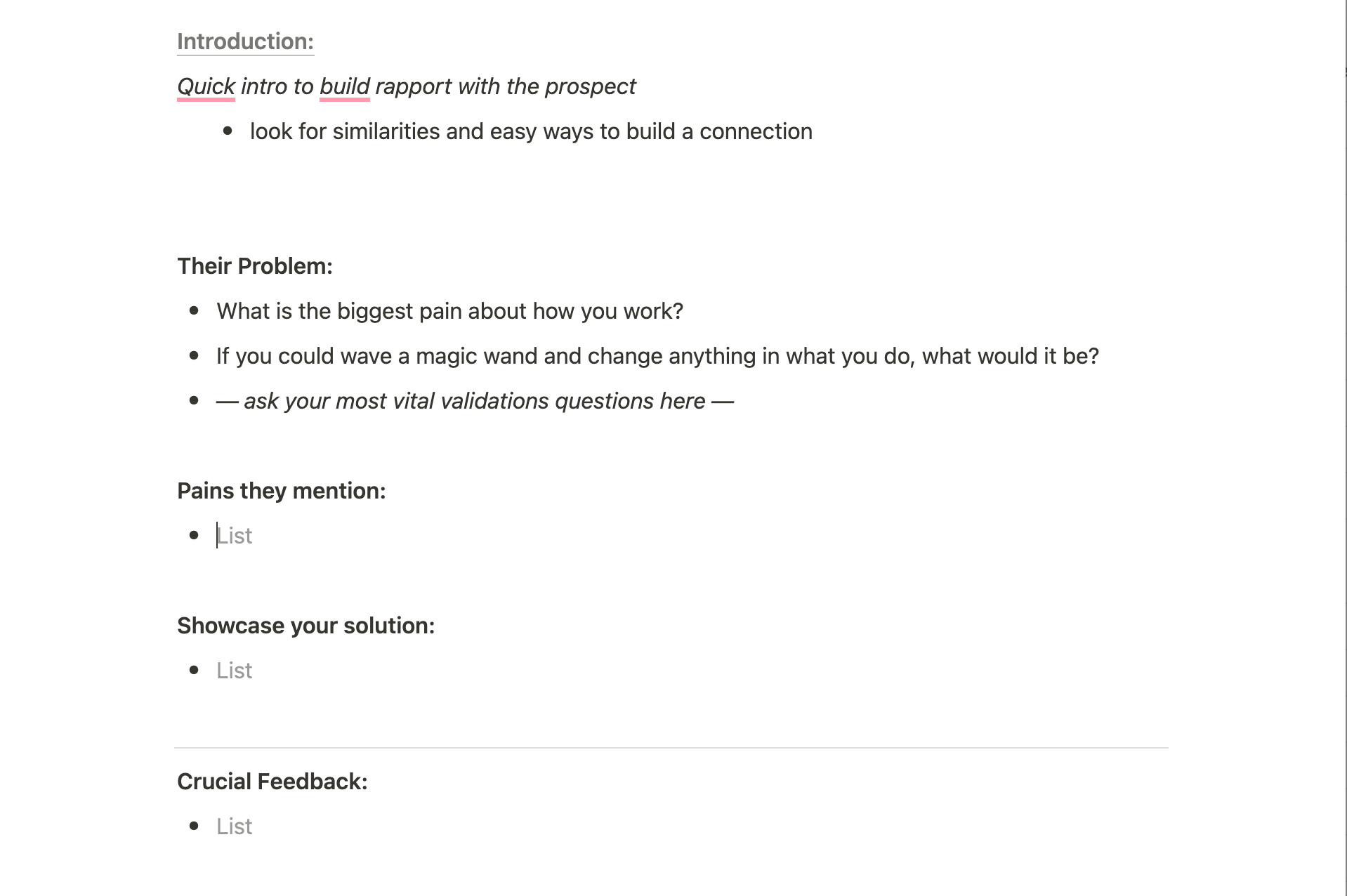
I created an interview page template in notion, which I treated heavily over time.
Benefits I see:
You stay on your line and are reminded of the questions you want to ask.
You can add notes to remind you of fallacies you want to improve, f.ex. not asking enough questions or being too influential during calls.
It makes it super easy to link it to other pages you might have on product features/critical assumptions, etc.
→ Here is a super simple template that I used for this approach a while ago
While these tactical questions were important, we also looked for how enthusiastic people were about the idea and our vision. I could tell when someone was suspicious of what we were building vs. when someone was excited about the concept, even though it didn't have all the features they needed to use it. The most enthusiastic people became our main ICP, and during the process, we tried to find more people like that.
💡 Pro Tip (as mentioned earlier): We found many of them by getting intros to people they already knew who had similar thoughts on the topic.
The learning curve during those first interviews is intense.
After 4-5 calls, I recognized patterns in how prospects talked about the topic and got way more comfortable in these demos, which enabled me to focus more on their gestures and mimics. This allowed us to identify who is hooked by the topic and who likes to talk but isn't interested.
Hint: Especially when you are reaching out via a cold approach, you'll find people who generally like to talk and chat. They might want to help you out, but don't care about your product idea. You must identify this quickly and adjust your approach based on that. These people might be friendly to talk to you but are a waste of time in the long run.
Founder Led Sales Process
Enough the talk! Let's dive into the process and explore how we've built out our Founder Led Sales process. This post aims to share actionable insights with you, my audience. So please let me know if you find this helpful.
1. Get in contact with your audience
First and foremost, you should have an exact picture of your persona. If you do not have that, go a step back and build it! I've always found the Hubspot persona builder helpful.
Note: Your persona should be more specific than "CEO of a Tech Startup." Try to go as deep as possible. F.ex. at Trana, we target Customer Success & Growth Leads at B2B SaaS companies with between 50-200 people working there. Generally, I'd say the more narrow you can get in the beginning, the better.
"Thanks, Max, but how do I get a full calendar with qualified interviews now?"
There are tons of possibilities for finding your persona and getting in touch with them. The most efficient ways I have seen were:
Intros from your existing network
Getting into niche communities and start conversations
Direct outreach via email/LinkedIn
There are no boundaries to your creativity. You can start a podcast where you invite thought-leaders from your industry and build an audience you can talk to or post on LinkedIn/Twitter about your topic.
Tools & Tactics
But let's get more actionable.
Since our goal is to have 2-3 quality conversations per day, we'd have to choose a scalable enough way to yield those results without doing too much pre-work, like building a vast audience in your field.
"But where do I find those people & how many do need to contact to book around 10-15 new calls per week?"
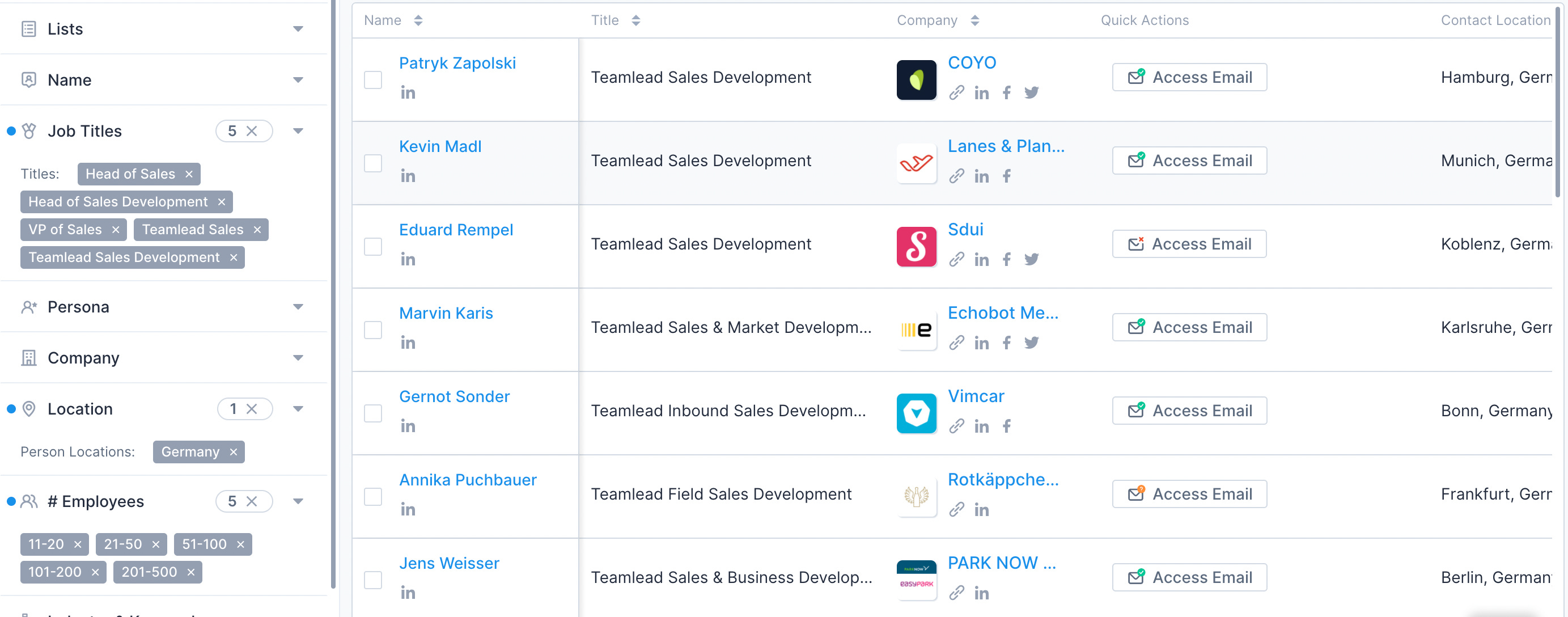
I'd start with using a tool like Apollo.io to create a narrow list of prospects you assume have a pressing problem you can solve with your product.
After that, you can use an email outreach tool like Lemlist.com to start creating a campaign. You can also do your outreach completely via LinkedIn (cheaper), but this comes with limitations on scalability since the platform aggressively limits the number of people you can contact. Since we are operating on a targeted basis here, it also makes sense to go solely with LinkedIn as a channel.
💡 I will write another article about LinkedIn Outreach soon → ; we focus on cold email outreach for this article
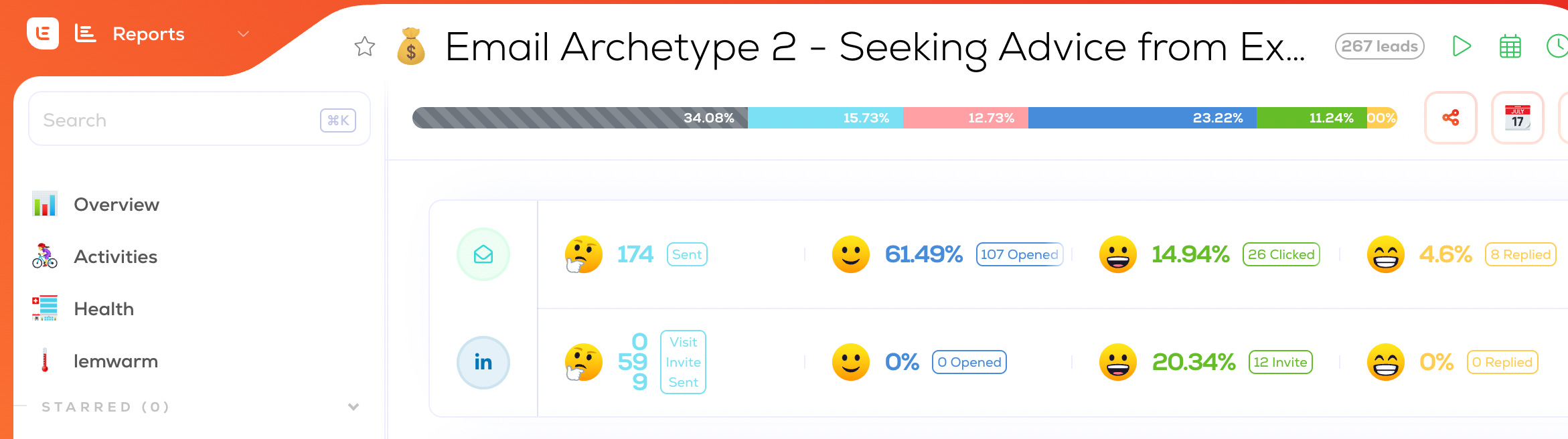
From my experience, a solid campaign should at least have the following metrics:
50%+ email open rate
10%+ click-through rate (on your call to action)
5%+ reply rate; 20%+ if you are insanely personal
Let's say you want to book ten customer calls per week; depending on how personal you get, you should at least reach out to 200 people per week on average. I'd go for even more since you will probably not hit those numbers in the first couple of weeks.
2. Drafting a compelling outreach message
On an abstract level, your email should contain the following parts:
A concise and personal subject line
Example of good subject lines
“Seeking advice on CS - {{firstName}} x Max
"Seeking advice on [relevant subject]."
Example of Bad subject lines:
"look at this...."
"URGENT!!"
"Let's connect
A Body copy that:
Hooks the reader
Explain why you're reaching out
twists the knife on a paint point you know your customer has
Predict target customers' hesitations and objections
Include a personal touch
Include one clear next steps
& Most importantly, it is concise
Some articles I’d recommend you to read on how to write great cold emails:
Extensive Guide by Woodpecker - A Sales Engagement SaaS solution
12 Cold Email Templates and Examples to Inspire Your Outreach by Demandcurve
3. The Demo Call
You've made it! You have your ideal prospects in a call. So what should you do now?
Keep it simple, but be prepared! When I ran demo calls, I used the following structure for my interviews:
Getting to know each other/building rapport
Asking prepared (mission-critical) questions to validate what we are building
Showcasing your product and start assessing fit for the prospect
Next Steps/Actions
Asking for Intros to other people in your ICP
If interested, → get onto using the product; scheduling out next steps
If not interested, → keep in loose touch
Pro tips:
Takes notes! You should take a lot of notes; the feedback people are giving you is crucial on your way to finding PMF.
Listen! Try to be as concise as possible and let your prospects speak; for that, I'd recommend you read gems like "The Mom Test" to ask intelligent and unbiased questions.
Beyond learning, our goal for demo calls was to get the customer onboard to our pilot program.
You want to give your people clear next steps.
When talking about action items and following up with demos, make it easy for the user to get started.
Think about creative ways of getting your potential pilots/users to use/test your product as frictionless as possible.
3.1 Standardize part of the process
As you'll notice, when running this process, you will have many tasks that can be automated, especially when it comes to email follow-ups. I outline parts of the process that can be automated right from the beginning using a CRM like Pipedrive or Hubspot, or even simpler by building email automation via Airtable or Notion.
Demo Invite → Send to people who sign up for a call with you via calendly or your landing page
Demo Follow Up V1 → Send this to people who were heavily interested in using your product
Demo Follow Up V2 → Send this to people who seemingly were as curious and keep in loose contact with them
3.2 Scheduling software
Since many of you are reading this have lots of stuff on your plate, I'd recommend scheduling a specific time during the day when you are free to take on calls. F.ex. block a time between 14.00-17.00 for people to book calls with you.
To ease the scheduling process and send automatic reminders to people, we use Calendly, but you can also use free, open-source tools like cal.com.
I urge you to implement a tool like this since it will be a huge time saver.
4. Tracking your funnel
I wouldn't recommend you to run a complex funnel system in the early stages.
Like I said before, keep it simple!
A process like the following should be sufficient for your needs in the beginning:
Reached out
Follow Up
Not interested
Meeting Scheduled
Demo Held
Onboarded
Customer - Active
Closed - Lost
You can create a Kanban Board inside Notion or Airtable to track this end-to-end.
Keep it simple. The key to success is not to have everything figured out and to build complex processes from the beginning, but to be flexible and test as quickly as you can.
I review this every day to see where people are in the funnel, and then I ask myself how I can move them to the next stage. We also review this pipeline in our team meeting each week, so everyone is on the same page about customer conversations.
And never forget, take a lot of notes and document your learnings during this process!
If you found this article helpful, I would love nothing more than to share this with people you think to find this useful.
If you think this article was a waste of your time, let me know as well. ;)
My goal is to make these posts as valuable to help early-stage founders to scale their products
Where to go from here/other exciting reads?
Thank you for this great article, in which I fully find myself as a founder. Our sales process looks similar and I can only recommend to set up clear structures from the beginning (how to track pipeline, forecast or to do follow-ups). Looking forward to more content!